On 30 November 1970, five weeks into Doonesbury’s run, protests against the Vietnam war began to figure into the strip’s plot lines after “Megaphone” Mark Slackmeyer tried to occupy the offices of Walden College’s president. The potential real-world stakes of antiwar activism came into play a few days later when Mark, after being suspended for his radical activities and thereby losing his draft exemption, received his conscription notice. Mark’s one-man protest, however, wasn’t the first time in 1970 that antiwar activism featured in a syndicated comic strip.
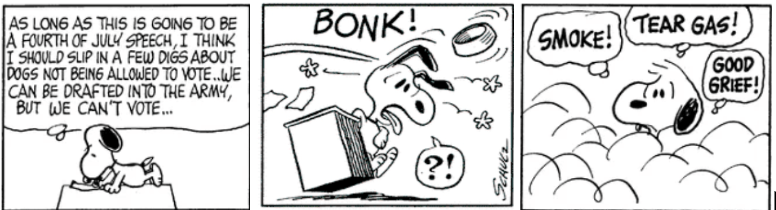
In a Peanuts sequence that ran in July 1970, Snoopy was scheduled to give an Independence Day speech at the Daisy Hill Puppy Farm. While Lucy suggested that he talk about “the new women’s liberation movement,” Snoopy wanted to focus on an issue arising from the war in Vietnam, namely how “dogs can be drafted into the Army, but can’t vote.” Right as Snoopy was being introduced, however, the crowd at the Daisy Hill Puppy Farm turned ugly. Snoopy was struck by a supper dish thrown from the crowd; a riot broke out, and police tear-gassed the meeting. The next day, Linus read in the paper that the dogs had rioted over the issue of their fellow canines “being sent to Vietnam and then not getting back.”
During the Vietnam war dogs were, in fact, drafted into service, and while Snoopy’s idea about granting them the franchise didn’t figure into public debate, there were concerns about their fates. During the week of the Daisy Hill Puppy Farm uprising, the New York Times ran a profile of Chief, a “three‐year‐old black and silver, 80‐pound German shepherd” who served with the 34th Scout Dog Platoon based near Saigon. Not only could Chief not vote, he couldn’t return Stateside when his tour was done, out of concern for a locally-prevalent tick-borne disease called tropical canine pancytopenia. As one former handler noted, dogs like Chief were, as far as the army was concerned, mere “equipment,” and many were abandoned or euthanized at the end of their working lives.
Blake Scott Ball frames the Daisy Hill Puppy Farm uprising as a commentary on ongoing debates about how men old enough to be drafted had no say in the choice of the political leaders forcing them to go to war, a situation that was eventually resolved with the passing of the Twenty-Sixth Amendment, which mandated that voting eligibility be fixed at age eighteen. Beyond the reference to debates over conscription and voting, the Daisy Hill Puppy Farm uprising evoked a tragedy that had occurred only weeks earlier: the Kent State massacre. Assuming a lead-time of six weeks between Schulz drawing a strip and its appearance in the funnies, those murders could well have been on Charles Schulz’s mind when he imagined the Daisy Hill episode. Certainly, they still occupied a significant space in the public conversation.
When Schulz retired in 1999, Garry Trudeau wrote a tribute to the cartoonist titled – in a riff on the punchline of the first Peanuts strip – “‘I Hate Charlie Brown’: An Appreciation” (…reprinted in Volume 19 of The Complete Peanuts). Trudeau begins by recalling an evening he’d spent commiserating with two political journalist friends over how none of their work had ever “[made] the slightest bit of difference” or had “any meaningful effect on the course of events.” For Trudeau, only two cartoonists had ever made a difference: Bill Mauldin, whose Second World War cartooning had “[provided] the balm of laughter” to soldiers fighting fascism, and Charles Schulz. Peanuts – “the first postmodern comic strip” – “completely revolutionized” cartooning by revealing new possibilities in the comic arts and thereby “giving permission” to new generations of cartoonists “to write from the heart and intellect.”
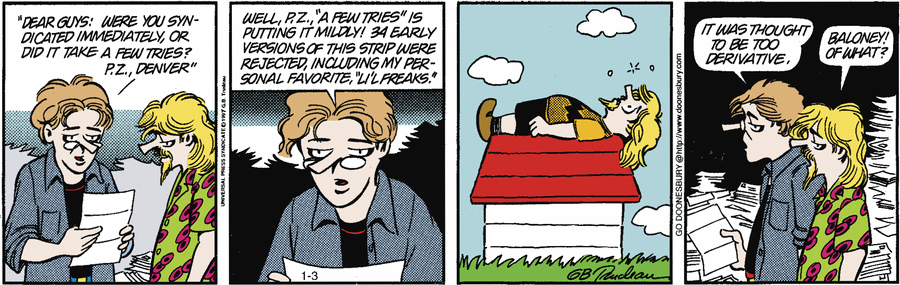
The novelist Jonathan Frantzen notes a critical difference between Doonesbury and Peanuts. The former is essentially a literary strip; the latter is much more grounded in its visual language. GBT, he writes, is “essentially a social novelist” whose characters could “be translated into words with minimal loss of information.” A character like Linus, however, “consists, first and foremost, of pen strokes”; any attempt to depict him solely in words would “inevitably diminish” him. Yet while the two strips represent very different approaches to cartooning, Schulz’s influence on Trudeau’s work is undeniable. References to Peanuts are scattered throughout Doonesbury. In a recent Rolling Stone essay about Schulz, Trudeau notes that when Zonker “took a deep dive into his imagination and surfaced as a German U-boat commander navigating Walden Puddle,” it was an homage to Snoopy’s World War One Flying Ace persona. An early-2000s reader mailbag sequence reveals, tongue firmly in cheek, that an “early version” of Doonesbury had been titled Li’l Freaks (a nod to Li’l Folks, a strip Schulz drew before Peanuts); in a flashback Zonker lies stoned out of his gourd on Snoopy’s doghouse, wearing Charlie Brown’s trademark striped shirt. There are other elements of Trudeau’s work that hint at his love for Peanuts: I’ve written about how Honey Huan clearly evokes Peppermint Patty’s sidekick, Marcie. I’ve also written about B.J. Eddy, the White House “Head Tulip” who was unceremoniously uprooted by the incoming Carter Administration in 1976: the title of “Head Tulip” is a nod to Snoopy’s role as the “Head Beagle.”
Trudeau cops to Schulz having a “poor opinion” of his cartooning skills. The early Doonesbury strips, Schulz believed, “made the neighborhood safe for bad art.” Even if Schulz wasn’t a fan of GBT’s drawing style, elements of Schulz’s visual approach are woven throughout Doonesbury. The first few months’ worth of Doonesbury strips are very crudely drawn, but they also point to a lesson Trudeau took from Schulz: the use of empty space with backgrounds often hinted at with a few lines instead of being drawn in detail. Moreover, like Schulz, Trudeau embraced stillness, often drawing little more “action” than two people talking to each other (… though Schulz also did lots of dynamic work, especially in sports-themed strips and strips featuring Snoopy). As Trudeau’s art evolved, he featured much less white space in his panels, but he took Schulz’s ability to minimize movement to new levels, to the point where some postulated that he was simply photocopying the same drawing of the White House across multiple panels. Alongside these visual influences, Trudeau also took a degree of rhythmic inspiration from Peanuts: both strips often follow a cadence in which a final punchline in the fourth panel digs deeper into a gag or an insight from the penultimate panel.
Trudeau writes that – notwithstanding nods to events unfolding on the front pages of the newspaper like Women’s Lib or the draft – Schulz believed that Doonesbury’s explicit focus on topical themes favoured “ephemeral snark” over the “timeless, universal truths” he explored in Peanuts. He may not have favored Trudeau’s explicitly topical approach, but sequences like the Daisy Hill Puppy Farm uprising demonstrate how, by the time Doonesbury had debuted in 1970, Schulz’s cartooning increasingly reflected the tumult that America had been experiencing over the previous two decades. Media scholar Robert Thompson called Peanuts “arguably the longest story ever told by a single artist in human history.” While Trudeau’s use of an inker/assistant may preclude him from taking that title from Schulz, both Peanuts and Doonesbury share a history as half-century-long running cartoon commentaries on the changes and challenges that faced America in the decades following the Second World War.
Peanuts expressed timeless insights about the human condition while being firmly rooted in its particular moment. The cartoonist Chris Ware sees the Peanuts strips of the 1950s as resonating with the “postwar economic euphoria” America was then experiencing; the Peanuts kids seem to enjoy comfortable middle-class lives and there’s no hint that their families face any real material struggles. Yet even in those early years, Peanuts reflected how that “economic euphoria” existed alongside deeply-seated doubts about the world’s ability to offer security, expressing an existential dread that troubled 1950s optimism. The writer and cartoonist Sarah Boxer argues that the darkness that “floated freely” through Peanuts “went against the tide of the go-go 1950s”; Trudeau sees Schulz’s cartooning as part of a broader cultural pushback against the prevailing wisdom of the age, that Americans had never had it so good. Peanuts, he writes, was “the first Beat strip,” “[vibrating] with 1950s alienation.” Other cartoonists have made similar observations: Jimmy Gownley, co-host of the Unpacking Peanuts podcast, recently described Schulz as an artist who didn’t reflect Beat spirit as much as he helped create it.
By the mid-1960s, Schulz biographer David Michaelis observes, Peanuts had become a “cultural powerhouse” as Schulz’s cartooning reflected some of the foundational changes America was experiencing without crossing the line into the kind of explicitly political cartooning that Trudeau would bring to the funny pages. Ball’s Charlie Brown’s America explores the politics of Peanuts as the long 1960s unfolded. The Daisy Hill Puppy Farm uprising wasn’t Schulz’s only commentary on Vietnam: Snoopy’s adventures as the World War One Flying Ace are a prolonged meditation on the horrors of a nonsensical war; Franklin joined the cast of Peanuts only months after the murder of Martin Luther King sharpened racial tensions; Peppermint Patty embodies the contradictions women encountered between enjoying new opportunities and still facing a profoundly patriarchal system as Second-Wave feminism challenged but did not undo traditional thinking about gender. Peppermint Patty advocated for the equal treatment of women in sports (one of Schulz’s favorite causes; feminist tennis star Billie Jean King was a longtime fan and friend of Schulz) and fought for the freedom for women to choose what they wear, but she also obsessed over how she didn’t fit traditional beauty standards and feared that she therefore would never find love.
As he explored the changes America was experiencing, Schultz’s visual vocabulary was widely adopted by the people and institutions living through those changes and Peanuts imagery became iconic both within the mainstream and an emerging counterculture. Grateful Dead keyboardist/vocalist Ron McKernan was better known to fans and bandmates as “Pigpen”; Snoopy iconography was widely popular among American troops in Vietnam; the Apollo 10 command module was named “Charlie Brown,” its landing vehicle was named “Snoopy”; Robert L. Short’s 1965 study of Christian theology, The Gospel According to Peanuts,” sold over ten million copies; giant balloons depicting Schulz’s characters have been a staple of the Macy’s Thanksgiving Day parade since 1968.
As Schultz’s cartooning reflected the changes facing America during tumultuous times, it helped people navigate those changes. The near-ubiquity of Peanuts imagery in the 1960s, Michaelis argues, speaks to how Schulz’s “visual and verbal vocabulary” helped bridge older and younger Americans who often found themselves on opposite sides of a growing “generation gap”: Linus’s security blanket and the mantra that “Happiness Is a Warm Puppy” helped ease anxieties as young people questioned and challenged the world their elders had bequeathed them.
In Doonesbury, that generation gap played itself out in the relationship between Mark Slackmeyer and his father, Phil. The two men were never able to communicate, each seeing the other as standing against everything he believed in. In their first joint appearance, Mark, home from college for Christmas break, responded to his father’s demand that he get a haircut by sarcastically giving the old man a Nazi salute. Thirty-one years later, Mark, hoping to mend their relationship, tried to open up a discussion with Phil about his experiences in the Second World War. Phil dismissed his son as “another Boomer with hedgerow envy.”
Frantzen witnessed the same “generation gap” that separated Mark and his father when he was a child in the 1960s; Peanuts helped him get through it. Frantzen’s brothers were significantly older than he, so he grew up feeling isolated. He recalls rereading a hardcover Peanuts collection every night, identifying especially with Snoopy, the “solitary not-animal animal who lived among larger creatures of a different species.” The comfort Frantzen found in Snoopy’s “ridiculous fantasies” helped him navigate a family crisis that reflected the inter-generational dynamics of the era. His brother ran away from home after fighting with his father, who didn’t approve of his plan to switch from a major in architecture to film studies (…much as Phil Slackmeyer refused to support Mark’s decision to follow a career in radio). When his brother came home and his family tried to move forward, Frantzen understood how Peanuts had given him a glimpse of something impossible in the world he inhabited: “I wanted to live in a Peanuts world, where rage was funny and insecurity was loveable.”
The world that Garry Trudeau created and has spent nearly sixty years exploring might be said to reflect the world that Frantzen imagined as his family navigated the tensions and conflicts of their times. Trudeau has made rage at crooked, mean-spirited, incompetent figures like Nixon, Kissinger, Reagan, Clinton, Trump and so many others hilarious, and characters like Mike, Mark, Zonker, Joanie, and B.D. (…and many more) are each in their own way loveable as they faced and continue to face the insecurities of life in modern America. I want to dig a little deeper into the ways in which Schulz influenced Trudeau’s work. One place where that dynamic is evident is in how Trudeau has depicted childhood in his cartooning. Next time out, the Doonesbury kids.
Stay tuned.


