Last time out, I examined how events such as COVID, Donald Trump’s failed coup d’etat, and his subsequent legal woes contributed to Garry Trudeau – reflecting a broader trend among more liberal Americans who’ve lost patience with their MAGA co-citizens – turning his pen against those who had abandoned their civic responsibility to support a politician who represents an existential threat to American democracy. I ended by noting an observation that Trudeau made in the preface to Day One Dictator, the most recent volume in his ever-growing collection of comics about America in the time of Trumpism. The book was nearly titled Day One Dementia: put together, the competing titles draw attention to something compounding Trumpism’s threat to American democracy. MAGA fanaticism, Trudeau argues, blinds Trump supporters to something obvious to even the most casual observer: the fact that Trump is losing his mind.
In a normal world, Trump’s mental health issues and his creeping senility would disqualify him from high office. If those factors didn’t, the fact that he has been found civilly liable for sexual assault, boasted on tape about forcing himself on women, and faced numerous credible allegations of being a sex pest – allegations dating back decades – would. In this post, I’m looking at how Trudeau has addressed the most troubling aspects of Trump’s personality: his mental illness and obvious cognitive slippage; and his well-documented reputation as a serial abuser of women. In recent weeks, it would appear, Doonesbury strips focused on Trump’s deteriorating mental health and his decades-long record as a sexual abuser may well have contributed to the strip losing its place on several of America’s comics pages.
***
Trudeau sees spoofing someone’s public descent into madness and senility as miserable work; it’s clear he’d rather be doing anything else right now. “It’s no fun mocking someone falling apart before our eyes,” he writes, but “given the country’s current glide path into calamity,” he sees no alternative.
GBT began paying attention to Trump’s mental well-being in the weeks leading up to the 2016 election. From the outset, Doonesbury pulled no punches: Trudeau didn’t just mock the candidate’s odd behavior and speech patterns, he outlined potential clinical reasons behind Trump’s repugnant character and behaviour, using terms usually reserved for mental health professionals. In October 2016, Mike, after hearing Trump bragging about how he “has a very good brain and [has] said a lot of things,” tells Kim that the upcoming election between Trump and Hilary Clinton is essentially “a referendum on mental health: do we, or do we not want a sociopath as president?”
Kim points out that, as he’s not a clinician, Mike shouldn’t be “diagnosing” anybody.
Mike dismisses her argument, noting that one doesn’t need to be a “trained ornithologist” in order to identify a duck: “if it rants like a sociopath and lies like …”
“Got it,” says Kim. “Fair point.”
Kim’s comment about the ethics of diagnosing people outside of accepted clinical boundaries is relevant to the public discourse about Trump’s mental well-being. The American Psychiatric Association (APA) holds its members to the so-called “Goldwater Rule,” which prohibits clinicians from commenting on the mental health of public figures they have not examined; the rule dates from 1964, after psychiatrists had publicly discussed Republican candidate Barry Goldwater’s mental health. In June 2017, a science newsletter reported that the American Psychoanalytic Association (APsA)– a different group from the APA – had told its members that they were “free to comment about public figures as individuals.” The report, which used the phrase “Goldwater Rule” in the headline, was widely circulated, feeding growing calls for mental health professionals to weigh in on Trump’s well-being. Subsequent reporting clarified the APsA’s position that “making a psychodynamic or diagnostic statement” about a public figure “would be unprofessional and alarming” (though it would not strictly constitute an ethical violation) and affirmed that the APA’s Goldwater Rule had not been modified.
Even with the confusion between the two groups’ stances, Trudeau took the opening to draw a strip featuring several shrinks diagnosing Trump with conditions ranging from malignant narcissism and anti-social personality disorder to sociopathy and “flat-out” psychopathy. As Mike points out in the final panel, “even the pros can’t agree” about what’s wrong with the man.
As the 2024 election approached, Trudeau returned to Trump’s mental state, but shifted his focus away from Trump’s psychopathology to his clearly diminishing cognitive abilities. An 14 April 2024 strip finds Trump upset because the results of a cognitive test he had recently “aced” weren’t mentioned in a speech he was set to deliver. Trump’s henchman Trfff tells his boss that by “constantly talking about” his cognitive tests, he ends up sounding “a bit demented.” Trump’s reply is loaded with the kinds of linguistic mishaps that can be symptomatic of cognitive struggles: instead of saying “dementia,” he uses the word “dimension” (“No-one knows more about dimension than me!”); stumbling over the word “vote,” he claims that his supporters “do the ballot so powerfully.”
Two weeks later, Trudeau called on Doonesbury’s resident mental health expert Elias to weigh in on Trump’s mental acuity. While the earlier panel of shrinks had suggested a number of possible causes for his erratic and weird behavior, Elias unambiguously diagnoses the patient’s cognitive skills: “Trump has dementia.” He notes that tics in Trump’s speaking patterns, like confusing names (on the campaign trail, Trump on several occasions confused Obama with Biden and Nancy Pelosi with Nikki Haley) are “classic” dementia symptoms. When Trump “freestyles off the stem of a word,” (“evangelish” for “evangelical”; “Venezwheregull” for “Venezuela”), Elias reveals, “that’s called phonemic paraphasia,” another sign of early dementia.
“If Trump were your grandfather,” Elias asks, “would you seek care for him, or would you make him leader of the free world?”
We get Trump supporters’ answer to Elias’s rhetorical question a few strips later: Trff, at campaign staff meeting, notes that while “no one cares that the boss wants to play dictator,” he wonders if anyone supporting Trump is “losing sleep over their role in trying to elect a demented dictator.”
Trff smiles contentedly as the staffers reply, chanting: “EIGHT MORE YEARS! EIGHT MORE YEARS!”
By openly lampooning Trump’s mental illness and cognitive impairment, Trudeau has demonstrated how, after more than a half-century on the gig, he is still able to push the boundaries of comics-page satire. At the same moment, he’s doubled down on that dynamic by drawing strips that draw attention to something even more unsettling than the fact that the President of the United States is both crazy and senile: he’s also a rapist.
***
Sexual violence isn’t typical fodder for newspaper comic strips, but Doonesbury has addressed the issue on a few occasions. In 2004, Trudeau used Boopsie’s stint as head coach of Walden’s football team to address the prevalence of sexual assault in college sports; shortly beforehand, he’d depicted Arnold Schwarzenegger as a giant hand (addressed as “Herr Gröpenfuhrer,” a play on a term with Nazi origins) after several women had accused the former bodybuilder and then-California gubernatorial candidate of sexual misconduct.
The Gröpenfuhrer appears in an early example of Trudeau attacking Trump as a serial abuser of women. Shortly after the 2016 election, Schwarzenegger paid a “post-election visit” to Trump’s office. A sullen Trump complains to the Gröpenfuhrer; he doesn’t understand why voters had “shrugged” after sixteen women had made allegations against Schwarznegger. “I only had a dozen,” he complains, “and everyone went crazy.”
I don’t try to get too far into Trudeau’s head; I’m more interested in how his observations speak to the broader political and cultural discourse of their moment than I am in Garry Trudeau as a personality. (Full disclosure: Garry and I have corresponded a bit, and he’s been very kind to me.) But there’s something about this strip that I can’t ignore.
Given the average comic-strip lead time, the strip was likely drawn a few weeks before the election, which occurred only twelve days before the strip ran. The version of Trump who meets with the Gröpenfuhrer is jealous because Schwarznegger won an election while facing multiple allegations of sexual misconduct – the implication being that Trump, in 2016, did not.
Those who say Trudeau was “prescient” about Trump’s presidency, take note: he seems to have thought Hilary Clinton was going to win, and that numerous allegations of sexual misconduct and the infamous “Pussy Tape” would be what sunk Trump’s political hopes.
That didn’t happen, and Trudeau returned to drawing comics about the numerous sexual allegations against Trump. Those strips find the cartoonist unambiguously and brutally skewering Trump for being found legally (though not criminally) liable for rape. On 14 January 2024, around the time of Trump’s second civil trial for defaming the journalist E. Jean Carroll after being found civilly liable for sexually assaulting her, Doonesbury readers saw Donald Trump, in the middle of applying his makeup, discussing his legal options with Trfff.
Trump remains convinced of his innocence, if only for semantic reasons: “How can it be rape,” he asks, “if it’s going to cost me $10 MILLION?” “Rape is FREE!” Trump insists: “By DEFINITION! Nobody pays for it!”
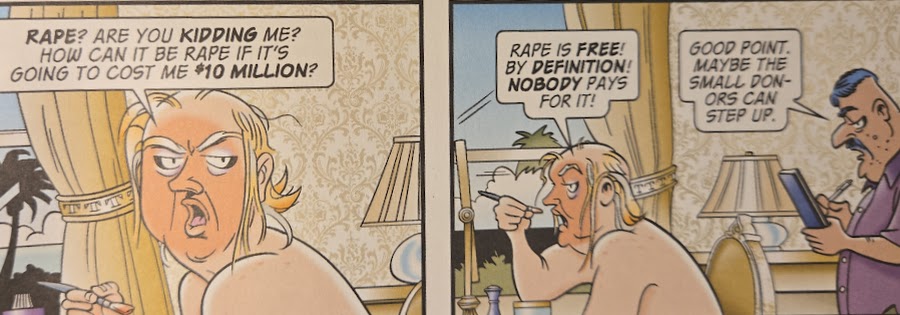
In my previous post, I pointed to the title page illustration of LEWSER! as an example of Trudeau expanding his visual repertoire to underline Trump’s fundamentally grotesque nature. The illustration, which depicts Trump as a monster – fat, wisps of dyed hair chaotically arranged on his head, applying garish makeup – is echoed in this strip. Seeing it in this context sharply underlines Trudeau’s purpose in picking on Trump’s horrifying appearance. Reading Trump say those appalling words while depicted as a nightmarish freak reveals him as the profoundly morally repugnant person that he is – a man who, for Trudeau, is devoid of basic humanity.
Trudeau has continued to remind readers that Trump is a rapist – the April 2024 strip mentioned above, in which Trump and Trff discuss his mental acuity, begins with Trump boasting about people congratulating him for having “normalized rape so beautifully” – but a recent strip about Trump’s history of sexual violence may have generated some backlash for the cartoonist.
Soon after Trump’s second inauguration, we find Mark and Mike in the mailroom, addressing a reader inquiry: Karen P. wants to know if the Doonesbury crew is worried that, since he has sued media outlets for running negative stories about him, Trump will come after them. Mark replies that Doonesbury is “indifferent to Trump’s wrath” for two reasons:
First, Mark asserts that because GBT and Trump “go WAAAY back,” (as we’ve seen, Trudeau has been lampooning Trump since the 1980s) the President is unlikely to take action against the cartoonist at this point. More importantly, he continues, Hustler v. Falwell, a landmark SCOTUS ruling from a case pitting pornographer and free-speech fundamentalist Larry Flynt against the televangelist Jerry Falwell, found that satire of public figures, including instances involving “allegations that have no basis in reality” is protected speech, guaranteeing Doonesbury’s freedom to go after Trump. In fact, Mark notes, Trudeau and Doonesbury “were even cited in the winning argument,” when Flynt’s attorney noted that his client’s satirical allegations about Falwell (including ones that involved obviously fictional allegations about the televangelist committing incest with his mother) “served the same public purpose [as] having Trudeau in Doonesbury call George Bush a wimp.”
I’m not arguing for a direct cause-and-effect relationship between that strip and what happened soon after it ran, but it conceivably may have been the last straw for some newspapers. A few weeks after the cartoon appeared, the Dallas Morning News dropped new Doonesbury Sunday strips from its comics page (though it will continue to publish the weekday reruns). The paper explicitly cited the political dimensions of GBT’s work in its rationale for cancelling the strip. Managing Editor Amy Hollyfield said that Doonesbury had been unfair to Trump, and likened running the strip to making a political endorsement. She did not want to see the paper become “a microphone for a comic that has gone on a crusade against the president.” Grant Moise, the paper’s publisher/president said that if a “comic strip … detracts from [the] goal” of being perceived as being “rooted in fairness and balance,” then the editorial staff “must make decisions supporting our objectives and values.”
Around the same time, CNHI, a company that owns newspapers all across the United States, instructed its papers to pull Doonesbury from their pages. In contrast to the Morning News’s overtly political justification for dropping the strip, the Daily Star of Oneonta, NY, a CNHI paper, ran an editorial about the decision that disavowed any political motivation. The paper maintained that the call was based on instances where Trudeau had “crossed boundaries of good taste”: characters like Mr. Butts and strips like one from February 2024 in which Zonker and Zipper discuss “a 3D-printed ‘Stoner Barbie’ with a physique ‘not found in nature’” went too far for CNHI. The Daily Star noted that its “editorial board and parent company often align with Trudeau’s viewpoints. However, we do not always align with his method of delivery … The issue is not the topics being addressed, but how they are presented.”
Given the current political climate, CNHI’s stated decision for yanking Doonesbury feels like a cop-out. In a response to the Dallas Morning News’s decision, Trudeau focused on the politics explicitly cited for the strip’s removal. While he conceded that editors have the “prerogative” to decide what runs in their paper, and pointed out that it would be “categorically wrong” to accuse the Morning News’s editors of “censorship,” Trudeau pointed out that he had to remain true to “the satirist’s mission statement: to afflict the comfortable and comfort the afflicted.” “Unlike Fox News,” he continued: “I don’t cynically pretend to be ‘fair and balanced.’ For a satirist, that’s a contradiction in terms.”
In his comments about Doonesbury getting pulled from the Morning News, Trudeau notes that Trump’s “actions and behavior infect and impact every corner of civic life.” He could turn his pen to other targets, like mocking how the Democrats are in “complete disarray right now,” but he doesn’t see the point of hitting those who are already down. Trump’s fundamental personal and moral flaws – flaws that generate what the cartoonist calls a “firehose of awfulness” – will, it seems, continue to be Doonesbury’s central focus as the strip’s sixth decade unfolds. Next time out, I’ll have some concluding thoughts about Doonesbury, Trump and satire in an era where reality is already a spoof of itself.
Stay tuned.

 Reading Doonesbury