In his introduction to a 1968 compilation of cartoons about Lyndon Johnson, Jules Feiffer quoted an 1831 essay describing political cartoonists as those who “insult inferiority of mind and expose defects of body … [and] aggravate what is already hideous,” about their targets. Good political cartoonists, Feiffer continued, had “a blackmailer’s savvy,” allowing them to produce caricatures that become “a psychic doppelganger” of their subjects. If this was the standard by which to measure his and his peers’ work about Johnson, Feiffer argued, they had fallen short. This was, in part, a product of the political culture of the times. Even in tumultuous times like 1968, Feiffer speculated, “undisguised hate” towards elected leaders was “less marketable.”
Since 1987, Garry Trudeau, who cites Feiffer as a key influence, has insulted the inferiority of mind, exposed the defects of body, and aggravated what is hideous about Donald Trump, a man for whom he has always had undisguised contempt, if not hate.
When Trump became a serious contender for the presidency in 2016, GBT’s publisher compiled thirty years of Doonesbury strips about him going back to 1987, when The Donald first floated the idea of running for president. Trudeau notes that the resulting volume, YUGE! was “supposed to be a cautionary recap of the life of a genuinely awful human being.” America’s failure to heed Trudeau’s cautionary tales necessitated the extension of that volume into what ultimately became a “Trump Quintet,” (Yuge!; #SAD!; LEWSER!; Former Guy; and Day One Dictator) chronicling Trump’s time as a political figure and how it intersected with several Doonesbury characters.
The personal relationship between cartoonist and subject is woven through the Quintet. For decades, Trump has clapped back at Trudeau’s satire with petty insults that GBT wears as a badge of honour. The cover art of the Quintet’s first three volumes highlights quotes from Trump insulting Trudeau and his work (“A third-rate talent who got lucky”; “I just don’t get these so-called jokes”; “A total loser!”). Trudeau’s publisher also weaves these blasts into the books’ “about the author” blurbs. From YUGE!:
Garry Trudeau is the ‘sleazeball’ cartoonist who draws the ‘overrated’ comic strip Doonesbury which ‘very few people read.’ He lives in New York City with his wife Jane Pauley, who has ‘far more talent’ than he does.
The design of Former Guy, Doonesbury’s fourth Trump collection, moves away from highlighting Trump’s inability to take a joke to focus more squarely on the existential political threat that Trumpism poses: the rear cover features Trudeau’s rendering of the scaffold the January 6 insurgents built in front of the Capitol, overlaid with Trump’s message to his goons: “We love you, you’re very special.” The rear cover of Day One Dictator ties Trump directly to Hitler with detail from a strip that featured a reproduction of a 1921 New York Times article about how the “demi-god of reactionary extremists” and future dictator had been “tamed by prison.”
This post examines how, starting in 1987, Trudeau documented and satirized events that helped bring Trump to the White House while weaving him into the larger Doonesbury storyline. Reading Doonesbury’s entire Trump arc in one sitting makes plain that while Trudeau might not have predicted a Trump presidency, he was keenly aware of unfolding dynamics that made such an abomination possible.
***
I bought my copy of YUGE! from a local used book shop. Pencilled on the inside cover is the price ($10.95) and a brief note: “Prescient!”
Garry Trudeau would be the first to deny any sort of prescience on his part. His Trump strips do what Doonesbury has always done: satirically chronicle American politics and culture, in this case the critical moments and dynamics that, over decades, turned a third-rate real-estate developer and attention whore into the most powerful person in the world, not once, but twice. Trudeau didn’t foresee a Trump presidency, but he understood the rot which had settled into the system and helped make that outcome possible: in fact, Trump’s first mention in a Doonesbury strip explicitly tied him to a politics that four decades ago was already gaining the kind of traction that would bring him to power, one built on racism, misogyny, and cronyism.
In 1987 Evan Mecham became Arizona’s governor. Mecham gained national attention for racist and sexist acts like cancelling Arizona’s recognition of MLK Day, using a racial slur to describe African-Americans, and blaming divorce rates on working women. He also made a number of bizarre decisions, including appointing a man being investigated for murder to lead the state liquor board.
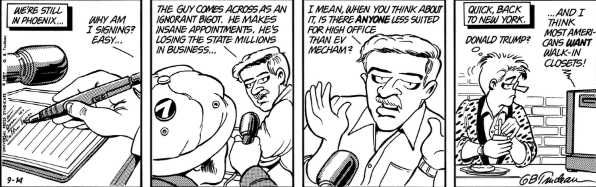
In a 1987 strip, a frustrated Arizonan describes Mecham as “an ignorant bigot” who had made “insane appointments” and was “losing the state millions in business.” When you think about it,” the man asks, “is there anyone less suited for high office than Ev Mecham?”
We get the answer to that question in the strip’s final panel: we jump “back to New York,” where Mike watches in disbelief as Donald Trump openly flirts –not for the last time – with the idea of running for president.
While Trump’s first gestures at a political run didn’t amount to much, in October 1999 he again explored the possibility of a presidential campaign; this convinced Honey that Duke could also mount a viable candidacy. She sees Duke’s opening in a degradation of American political culture that dated back to the early 1980s:
It’s been coming for years – Reagan broke the ignorance barrier, Bush destroyed any need for vision. Gingrich trashed the civility requirement, Clinton eliminated propriety, and Ventura got rid of dignity.
As Trudeau saw it, the flawed politics and character failings of two previous generations of politicians laid the groundwork for what was to come long before Trump took the Oath of Office – a total sleazebag winning the presidency. Duke’s campaign is worth its own examination, but what’s important here is Duke’s easy embrace of the kind of sleaziness that Trump personified. When Trump hinted that he might marry his Slovenian nude model girlfriend and make her First Lady, Duke panics: he needs his “own bimbo …to match the big boob boob for boob.” Duke understands that he “can’t afford to cede Trump the dirty old man vote,” and tries to hire an escort as his First Lady.
Another piece of the groundwork that made Trumpism possible was the fracturing of a widely-shared “consensus reality” among the body politic. Trudeau centered Trump in episodes that examined the political effects of a fraying shared epistemology. In 2012, Trudeau introduced “MyFacts,” a service committed to the idea that “everyone is entitled to their own set of facts.” One of MyFacts’ first customers wants to prove that Obama is a Kenyan-born Muslim, an idea which got traction largely because Trump amplified those bigoted charges. Trudeau had already spoofed Trump’s public embrace of birtherism in April 2011; a bemused Mike watches as Trump boasts how people had been “begging” him to “investigate the truth” about Obama’s birthplace. Trump then announces the creation of a “world class investigation into Obama’s so-called birth,” headed by Sarah Palin. Arguably, without a media environment that allowed Trump to turn his racism into a political platform, his presidency would have been much less likely.
The War on Terror also played no small part in paving the way for a Trump presidency. MyFacts explicitly tied Trumpism to how the Bush Administration’s lies leading up to the 2003 Iraq War helped erode America’s shared commitment to objective reality. While MyFacts was introduced to readers in 2012, in a 2017 strip GBT retconned the company’s history of “privatizing the truth” to 2003. That year, as it became increasingly impossible to deny that the Iraq War had been justified by White House and Department of Defence disinformation, several Doonesbury characters teamed up to tell the nearly 70% of Americans who had fallen for the Bush Administration’s lies that there was “NO evidence of a link between Saddam Hussein and 9/11! None!”
That 2017 strip also reveals that MyFacts had been bought by Trump, “the most trusted name in bespoke information.” Newly rebranded TrumpFacts, the company’s best-selling product was an “altfacts package” providing “decent evidence for Mr. Trump’s wiretap charge against Obama.” Trump, it turned out, had been using the package while it was “still in beta.”
***
Two things separate Trudeau’s treatment of Trump from his caricatures of other public figures. First, unlike most Doonesbury strips featuring prominent personalities, Trudeau renders Trump as a recognizable version of himself, and he’s the only Doonesbury president who hasn’t appeared as either a disembodied voice or an icon. Trudeau’s early decision to draw Trump allowed him to later engage in a kind of physically-based visual satire that’s not typically part of his repertoire.
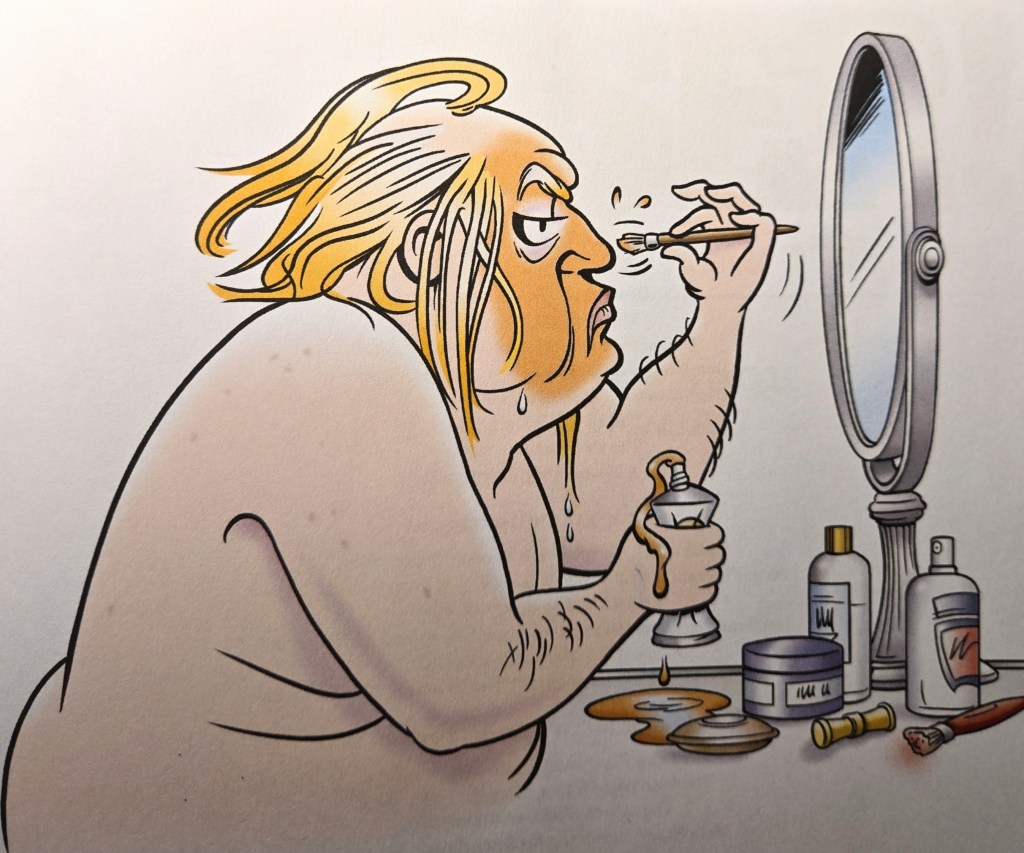
Initially, Trudeau’s renderings of Trump were fairly anodyne; the only change was in how he drew Trump a bit heavier as the man gained weight. In 2007, after Trump attacked talk-show host Rosie O’Donnel for her appearance, Trudeau began to focus on Trump’s own bizarre look with strips poking fun at his ridiculous hairstyle. From then, Trudeau’s depictions of Trump became increasingly grotesque. LEWSER!’s title page reveals Trump as a monster: heavily-made up, mostly bald, rolls of fat – he looks like a camp version of Dune’s Baron Harkonnen. When Trump’s incompetence led to the US having a COVID death rate substantially higher than in peer nations, Trudeau doubled down on his monstrous depictions of Trump by covering his hands in dripping blood.
The second thing separating GBT’s Trump strips from his other work about prominent personalities is the extent to which Trudeau has consistently woven Trump into storylines involving established characters, especially Duke. In 1988, Trump hired Duke to captain his yacht, the Trump Princess; soon after, Honey came aboard as social director, and Trump hired JJ to paint a mural in the boat’s bathroom. In 1989, Duke facilitated an interview with Trump for Mark; this encounter set up Duke and Trump’s plot to release Honey from a Beijing prison following the Tienanmen Square uprising. Duke worked for Trump again in 1997 when the failing casino owner needed some muscle to force out a mom & pop Italian restaurant that stood in the way of his hotel extension plans; Duke called on Elmont and Alice to round up local homeless people to act as pro-Trump protesters in front of the restaurant.
While there are numerous other instances when Trump storylines intersected with those of established characters, including Boopsie’s audition to appear on Trump’s game show (… her husband/manager BD lost her the gig with his overbearing demands that she be treated like a star), and Zonker’s plans to enroll in Trump University, it’s fitting that Trudeau wove Trump’s storyline so tightly with Duke’s. As I’ve written before, Duke plays a key symbolic role in Doonesbury, personifying the moral rot that had set into American culture and politics after the lies and upheavals of the “long 1960s,” notably how Vietnam and Watergate helped erode public trust in government. GBT explicitly tied Trump to the corruption Duke embodies: when the two men discuss a potential insurance scam, Duke tells his boss: “I can’t tell you how many people have told me we deserve each other.”
Trudeau doubled down on associating Trump with America’s moral failings by bringing Trff Bmzklfrpz, the former dictator of Berzerkistan, into Trump’s White House. Trff first appeared in 2007 as a client for Duke’s public relations firm, setting up a long relationship between the two of the biggest sleazebags in Doonesbury history. He joined the Trump White House in 2017 as “Deputy Director of Payback,” a position that put him in Trump’s “inner circle”; as “a third-generation authoritarian,” Trff notes, “West Wing culture is in my wheelhouse.”
As was the case with the MyFacts/TrumpFacts strip, bringing Trff into the White House tied Doonesbury’s critiques of Trump and Trumpism to a historical dynamic that was central to the strip’s narrative arc for two decades and to Trump’s coming to power: how the War on Terror helped further erode America’s inconsistent commitment to the rule of law with practices like torture, detention without trial, drone strikes on US citizens, and, specifically here, increased support for friendly and useful dictators who could present themselves as a “valued partner in the global War on Terror.”
As he wove Trump’s story into the Doonesbury timeline, Trudeau also revisited material from two previous presidents that had been targets for some of his hardest-hitting satire – Richard Nixon and Ronald Reagan – to attack Trump. In October 2019, Trudeau repurposed a Watergate-era strip capturing frustration at Congress’s unwillingness to remove an unfit president from office. (Trump was impeached for the first time two months later, though the Senate failed to follow through with a conviction). Trudeau also recycled the wall he had used to symbolize Nixon’s growing isolation during Watergate to attack Trump’s own brand of dirty politics and later to capture a palpable, though ultimately premature, sense of relief at Trump leaving office in 2021. Most famously, he brought back Mark’s pronouncement that key Nixon aide John Mitchell had been found “GUILTY! GUILTY! GUILTY!!” of crimes related to Watergate to comment on how, even if the Mueller Report partially exonerated him, Trump persistently behaved like a guilty man.
Trudeau also used callbacks to his Reagan-era work to draw a continuity between Trump and a previous president whose age – and creeping senility – marked his time in office. In 1980, Trudeau sent Roland Hedley on a mission to explore the workings of the brain of then-presidential-candidate Reagan; those strips focused on issues like Reagan’s inconsistent thinking and how, as a nearly seventy-year-old man, he was bound to be confronting the cognitive issues that come with ageing. In 2018, Hedley made a similar voyage into Trump’s brain, and observed that, among other things, that the prefrontal cortex, which manages “planning, judgement and social control” was vacant and that the only sound in the part of the brain responsible for compassion was the “drip, drip of sorrow into a pool of indifference.”
In the preface to Day One Dictator Trudeau reveals that the book might well have been titled Day One Dementia, and reflects on the possible consequences of electing a man who is clearly losing his mind to the presidency. Turning his attention to Reagan, Trudeau notes that while the former president might have been senile, he at least “had a good heart.” This wasn’t the first time GBT showed empathy for a politician whom he had savaged in his work: as I pointed out in a previous post, as Trudeau relentlessly went after Nixon during Watergate, he also drew strips that took on an affectionate tone, focusing on Nixon’s love for his wife and his role as a father and family man.
Trump gets none of that empathy from Trudeau. There are no good-natured jabs or affectionate barbs at Trump’s expense to be found in Doonesbury. In step with Feiffer’s description of the role of the political cartoonist, Trudeau’s version of Trump is “a psychic doppelganger” of the man, reduced to his rotten and corrupt core, not once allowing for any degree of shared humanity to color his portrayal of his victim.
Next time out, we’ll dig a little deeper into the Trout Quintet and how Trudeau radically pushed the limits of funny-page satire with his attacks on Trump.
Stay tuned.

 Reading Doonesbury
“he looks like an even more twisted version of Dune’s Baron Harkonnen.”
Baron Hark-Orange?
LikeLike