About a month or so ago, Garry Trudeau did an interview on Bud Mishkin’s Before the Cheering Started podcast. He mentioned that he rarely shows his freshly-completed strips to his family; for him, that would be as weird as a lawyer showing their partner a recent brief they had been working on.
There’s a great lesson in there about having healthy boundaries between one’s work life and the stuff that really matters, but GBT did admit that a strip he had recently completed amused him so much that he had to break that self-imposed rule and let his people in on the joke.
Every Sunday since that interview dropped, I’ve opened the Doonesbury webpage wondering if that week’s strip would obviously be the one in question. I don’t know how much lead time Garry works with, but I’m pretty sure that this week’s instalment is it.
I won’t spoil the joke – go read the strip and come back.
Complaints about the deteriorating environment of Twitter in the year since Elon Musk bought the site are pretty common these days, especially among journalists who rely on it to gather and distribute facts on the ground as they do their work, activists who use the site to amplify their messaging, and artists of all stripes who use it to build and connect with their audiences.
I’ve written briefly about GBT’s use of new technology as fodder for the strip, a theme which was central to the very first installment, which sees B.D. meeting his “computer selected” roommate, only to discover that there were “still a few bugs in the system.” It’s not surprising, therefore, that Trudeau has a take on a tech platform he’s been using regularly since 2016. Here, he focuses on Musk’s “boneheaded move” of taking one of the online world’s best-known brand names and replacing it with a one-character name (“X”) that, in the words of Alex Doonesbury, is “packed with negative associations, including “error, rejection … secrecy, danger, and even death.”
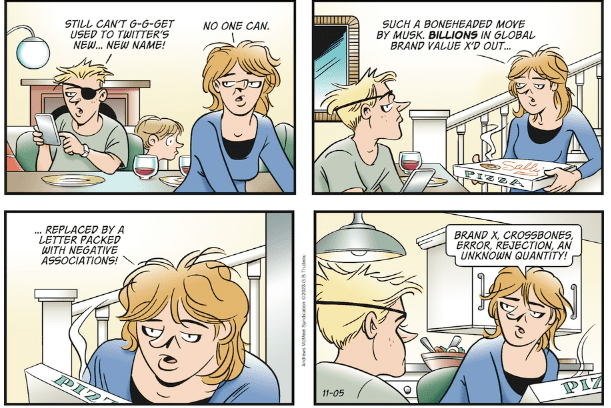
Alex’s partner Toggle, digging into a slice of pizza (from Sally’s, a New Haven pizzeria that has been a longtime Doonesbury staple), doesn’t quite buy her argument about that meaning: “Death? Oh. c’mon,” he says, as we see, in the final panel, another common use for the twenty-third letter in the English alphabet: Alex’s X-ed out eyes representing exactly that.
More than a few people rushed to Twitter (I’ll never call it anything else) to express concern that Trudeau had killed off a regular character; I even got a note from a reader of this little blog asking me if I thought Alex was dead.
Future strips might prove me wrong, but I’m reasonably confident that Alex Doonesbury is doing just fine.
Trudeau’s use of the X-ed out eyes is, in part, a nod to the work of KAWS, a Brooklyn-based artist strongly influenced by the Pop Art tradition. If you’ve seen his work, it’s probably been on a sweatshirt or handbag belonging to a teenager in your life or sitting across from you on the subway: a rendition of Charles Schulz’s Snoopy with comic-strip dead eyes in place of the normal dots. It’s an image that really creeped me out the first time it appeared in my classroom on a student’s t-shirt. Garry is a huge Peanuts fan, and he has, at a few points in his strip, included nods at the world of contemporary art. It makes sense that that last rendition of Alex is a knowing reference to KAWS’s work.
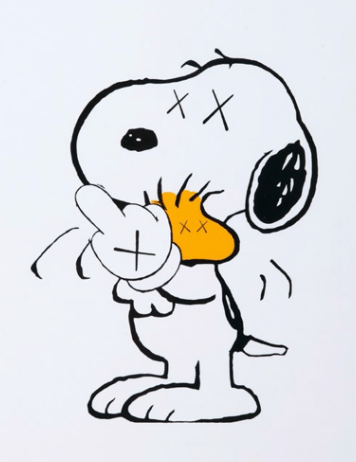
But it’s also, like KAWS’s Snoopy, not a simplistic indication that a character is dead. It’s a little bit darker than that, though in a more abstract way, one that reflects a general sense of darkness pervading our moment.
When my Old Man checked out a couple of years back, I wrote some reflections on how Trudeau had handled death and dying in his work. He has, over the years, killed off a few characters, but always in the service of telling a compelling story. Once he started ageing the cast in real time, it was only a matter of time before older characters like Dick Davenport came to the end of their allotted time. Sometimes a character’s death helped GBT nail down a critical political observation: Andy Lippincott’s death at the height of the AIDS epidemic put a relatable face on a crisis that was criminally ignored by a government that couldn’t see past its own hateful homophobia as its citizens were dying.
But no matter who died, Trudeau always approached the question with overwhelming sensitivity: there were, of course, gentle jabs and inside gags – it’s still the funny pages, after all – but he has never used tragedy to get a cheap laugh.
Killing off a character who was born and grew up on the comics page – a mother of twins and a loving and supportive partner to a wounded combat veteran, no less – would be an incredible tragedy. If Garry wanted to pursue that kind of a storyline, I simply cannot see him doing so as part of a gag criticizing an obnoxious tech-bro. It just wouldn’t scan with his longer history of writing about death.
Moreover, the current weekly format of the strip would make it almost impossible to pursue such a storyline: he no longer has the room to tell that kind of story. For the most part, Doonesbury is now built on standalone gags and observations, punctuated by regular “check-ins” with core characters who might then disappear for months or even years. As much as I have read him discuss how he wanted the focus of Doonesbury to be on telling compelling stories as he engaged in social/political/cultural satire, the Sundays-only schedule has really limited his ability to write the kind of extended arc that a major character’s death and the subsequent ripples it would cause through the extended Doonesbury family would merit.
So until I see otherwise, I’ll continue to assume Alex Doonesbury is alive and well.
So if Trudeau didn’t kill off a major character this week, what did he do?
Lately, I’ve been getting a lot of mileage out of a comment Trudeau made about a 1976 storyline about the forced retirement of B.J. Eddy, the White House Head Tulip: GBT recalled the episode with a sense of fondness because it played on a dynamic particular to cartooning: comics can help readers see the world in a more whimsical, child-like manner, one that may help reveal truths that our jaded adult minds are prone to overlook. The world is weird: kids see and accept that in a way that adults rarely do.
I’ve also long argued that part of Doonesbury’s popular success lay in the fact that GBT brought elements of the underground comix tradition to mainstream newspapers. What’s relevant here is that as much as the undergrounds could be silly and weird, they could also, as was fitting to the times from which they emerged, be very dark and weird.
Kids get that dark weirdness as much as they get its more whimsical forms. There are always monsters under the bed that they know about which we cannot see.
Our times are dark and weird, too; maybe darker and weirder than when B.D. and Mike were first hooked up by a bug in an early computer program. Alex’s X-ed out eyes, I believe (…and hope!!) represent Trudeau pointing to pretty scary dynamics that are currently unfolding – dynamics about money and power being put at the service of some extremely questionable characters. The monsters under the bed that we can’t quite see, but that leave us with a lingering anxiety and unease, are here made evident in the surreal appearance of a truly horrifying idea.
I’m pretty sure that the next time we see her, Alex will be back with Toggle and the twins as though nothing had happened: a comic-book death if there ever was one. In the meanwhile, when last Sunday morning came, I really appreciated seeing Garry pushing boundaries and showing us how he can still tap into “non-standard realities” in ways that can shock readers who have been with him for decades into seeing, symbolically, what’s “really” going on in a dark and weird world.

 Reading Doonesbury
One thought on “This Week in Doonesbury: Alex Is (Probably) Not Dead.”